A Little Bit of Everything: Homelabs, Ham Radio, Home Projects, and Everything in Between
It's been a while since I've sat down and written about everything I've been working on. Not because there hasn't been anything worth writing about, but because I've had so many different projects going on that finding time to document them has taken a back seat.
Between managing infrastructure, expanding my homelab, experimenting with radio communications, working on projects around the house, and taking care of an ever-growing collection of animals, there's rarely a dull moment.
So here's a rundown of what I've been up to lately.
The Homelab: Because Apparently I Don't Work With Enough Servers During the Day
My homelab has continued to grow and evolve, and what started as a way to experiment with technology has turned into a fairly substantial infrastructure environment.
At the center of everything is my Kubernetes cluster running K3s. I've been using a combination of Proxmox, Kubernetes, Longhorn, ArgoCD, and several other tools to build something that's relatively easy to manage while still giving me the flexibility to experiment.
One of the bigger changes recently was moving more of my infrastructure toward a GitOps model using ArgoCD. Rather than manually deploying applications and remembering what changes I've made, I can keep configurations in Git and let ArgoCD handle synchronization.
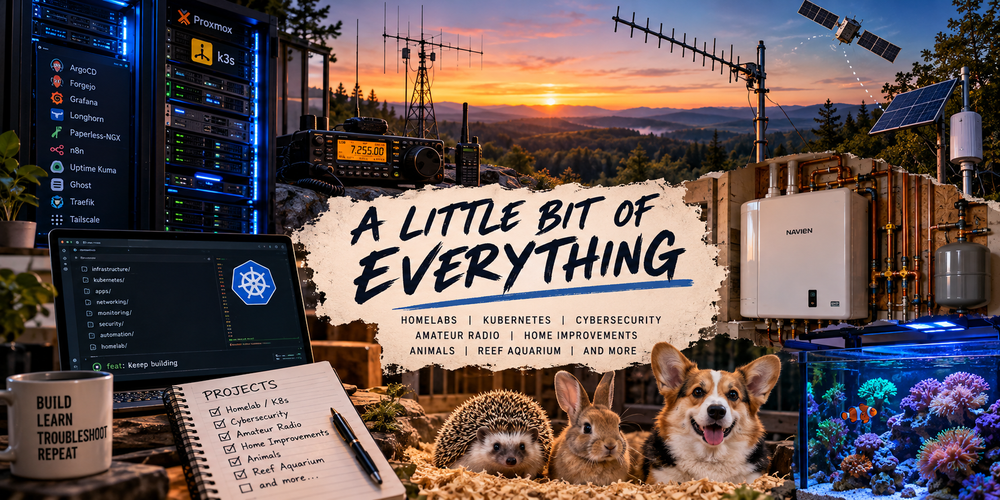
Some of the services I've been running include:
- Forgejo for self-hosted Git repositories.
- ArgoCD for GitOps and Kubernetes application management.
- Longhorn for distributed persistent storage.
- Grafana for monitoring and visualization.
- Paperless-NGX for document management.
- n8n for automation workflows.
- Uptime Kuma for service monitoring.
- Ghost for blogging.
- Traefik for Kubernetes ingress.
- Tailscale for secure remote connectivity.
I've also spent quite a bit of time working through networking changes, DNS configurations, persistent storage issues, and reverse proxy setups.
One of the more interesting recent projects has been getting Pangolin working as a way to expose selected services without directly opening up my home network. Combined with Caddy, Tailscale, and my existing infrastructure, it's another step toward making everything accessible without sacrificing security.
Of course, anyone who's worked with Kubernetes knows that half the fun is figuring out why something that worked perfectly yesterday suddenly refuses to cooperate today.
Cybersecurity, Linux, and Infrastructure
A good portion of my professional work continues to revolve around Linux systems, infrastructure, and security.
Lately, I've been spending a significant amount of time working with Wazuh, both from a monitoring perspective and in building out more useful alerting and reporting capabilities.
That includes tuning Linux audit rules, monitoring changes to sensitive system configurations, investigating suspicious activity, and trying to make security alerts meaningful instead of just generating more noise.
I've also been working on automating reporting and notifications so important events don't get buried in thousands of routine log entries.
On the infrastructure side, I've been digging into AWS resource utilization and cost optimization. It's amazing how much money can be spent on cloud resources that are oversized for their typical workloads, even when occasional CPU spikes make downsizing more complicated.
Between AWS, Talos Linux, Kubernetes, and traditional Linux administration, there's always something new to troubleshoot or improve.
One thing I've continued to appreciate is how much my professional work and homelab projects complement each other. Something I learn while experimenting at home often ends up being useful professionally, and vice versa.
Getting Back Into Amateur Radio
Another area I've been spending a lot of time on is amateur radio.
I've been experimenting with everything from traditional HF communications to digital mesh networking and satellite communications.
On the HF side, I've been working through antenna options, including end-fed wire antennas, vertical antennas, grounding, and radial systems.
I've also been troubleshooting interference around my radio equipment. Using a TinySA spectrum analyzer and a NanoVNA has been particularly useful for understanding what's actually happening instead of just guessing.
It's one thing to read about antenna resonance, SWR, and RF interference. It's another thing entirely to start measuring it and seeing the results firsthand.
MeshCore and LoRa
One of the more interesting radio projects has been experimenting with MeshCore and LoRa devices.
The idea of building a decentralized communications network that doesn't depend on cellular service or traditional internet infrastructure is fascinating.
I've been working with Seeed Studio hardware, solar-powered repeaters, external antennas, and different radio configurations.
There's been plenty of troubleshooting along the way, especially when it comes to antenna tuning, spreading factors, coding rates, and getting repeaters to communicate reliably.
A system that can receive messages perfectly but struggles to transmit them back out makes for an interesting troubleshooting session.
Satellites and Antennas
I've also been looking into satellite communications using my Yaesu radios.
Part of that has involved planning a DIY directional Yagi antenna and experimenting with different approaches to tracking satellite passes.
I'm also working toward expanding my antenna setup with a tower, which opens up quite a few possibilities for VHF, UHF, and HF operations.
Between tower planning, antenna selection, and figuring out the best installation methods, this is quickly becoming another project with plenty of room to grow.
Home Improvements: Plumbing, Boilers, and More Plumbing
As if the technology projects weren't enough, I've also been tackling some fairly substantial home improvement work.
One of the biggest projects has been replacing my existing heating equipment with a Navien combination boiler.
What sounds like a straightforward replacement has turned into a deep dive into hydronic heating, domestic water plumbing, expansion tanks, circulators, air separators, gas piping, venting, and mounting hardware.
I've spent a surprising amount of time tracing old plumbing lines to figure out exactly how the existing system was connected.
There's something particularly entertaining about discovering that multiple pipes eventually connect back into the same water supply and trying to figure out what the original installer had in mind.
The goal is to end up with a cleaner, more efficient, and easier-to-service system.
I've also been exploring backup power and solar options, particularly for the garage. Ideally, I'd like to build a system capable of supporting heating and cooling equipment along with a few essential appliances.
It's another project where the initial idea sounds simple until you start calculating actual electrical loads, battery capacity, inverter requirements, and how much solar generation you really need.
The Animals: A Completely Different Kind of Project
Outside of computers and radios, a lot of my time goes toward animals.
Between Valhal Exotics and Finrears Homestead Rabbitry, there's always something happening.
Hedgehogs, rabbits, rodents, and other exotic animals all have their own requirements, and maintaining appropriate environments takes a considerable amount of planning.
Recently, I've been working on improving ventilation and air filtration in the animal room.
With multiple enclosures sharing the same space, air circulation, odor management, and controlling airborne contaminants become especially important.
I've been looking at building a dedicated inline blower and carbon filtration system to improve air quality, while also investigating better ways to manage ammonia and ventilation.
I've also been spending time learning more about genetics and breeding.
Rabbit coat colors, mouse genetics, Corgi genetics, and the inheritance of different traits have all been interesting subjects to dig into.
There's a surprising amount of complexity behind something as seemingly simple as an animal's coat color or pattern.
The more I learn about genetics, the more interesting it becomes.
The Reef Aquarium: A Constant Balancing Act
My saltwater aquarium has also been keeping me busy.
It's a roughly 120-gallon display system with a sump, and like most reef tanks, it has a habit of presenting new challenges just when everything seems stable.
Lately, the main focus has been nutrient management and algae control.
I've been monitoring nitrate, phosphate, alkalinity, and other water parameters while experimenting with filtration media and different approaches to controlling nuisance algae.
It's an interesting balancing act because reducing nutrients too aggressively can create just as many problems as allowing them to climb too high.
Between the refugium, protein skimmer, mechanical filtration, and clean-up crew, there's quite a bit happening behind the scenes to keep the aquarium healthy.
It's another hobby where patience tends to be more valuable than constantly changing things.
Building, Breaking, Fixing, and Learning
Looking back at everything, there's a pretty consistent theme.
I enjoy figuring out how things work.
Whether that's deploying a Kubernetes application, tracking down a Linux security event, tuning an antenna, designing a plumbing system, or understanding animal genetics, the process is usually the same.
Start with an idea, research it, build something, discover what doesn't work, and keep improving it.
Sometimes things work on the first attempt.
Usually, they don't.
And that's part of what makes it interesting.
I've also been experimenting more with ESP32 microcontrollers and looking at ways to combine them with my radio projects. One idea I'm particularly interested in is building a desktop satellite pass tracker that can display upcoming amateur radio satellite passes.
It's a good example of how several different interests can come together into one project.
What's Next?
I've got plenty of projects still in progress.
The homelab will continue evolving, especially around networking, storage, monitoring, and automation.
I want to expand my amateur radio setup, get more antennas in the air, and continue experimenting with MeshCore and satellite communications.
There are still home improvement projects to finish, improvements to make around the animal facilities, and plenty of new things I want to learn.
I'm also hoping to spend more time documenting the projects as I go rather than trying to remember everything months later.
Part of the reason I enjoy maintaining a blog is being able to look back at what I've built, what I've learned, and how my approach to different problems has changed over time.
And if something I've documented helps someone else avoid spending several hours troubleshooting the same problem, even better.
For now, it's back to the never-ending list of projects.
There's always something else to build, fix, or figure out.